Solar power emergency - how to make clean water with solar energy and distillation

Introduction
Solar power can be used in many different ways. This article looks at some ad hoc ways of using solar energy in survival situations - specifically, to produce clean water.
It's not just the case that these stills and purification techniques can be used in the aftermath of a hurricane or civil emergency, though.
They are also useful in survival situations, and knowing how to build one is a Good Thing.
They are also a fun thing to do. I learned how to do this on a Girl Guide camp when I was bout 10 years old, and we all enjoyed it immensely.
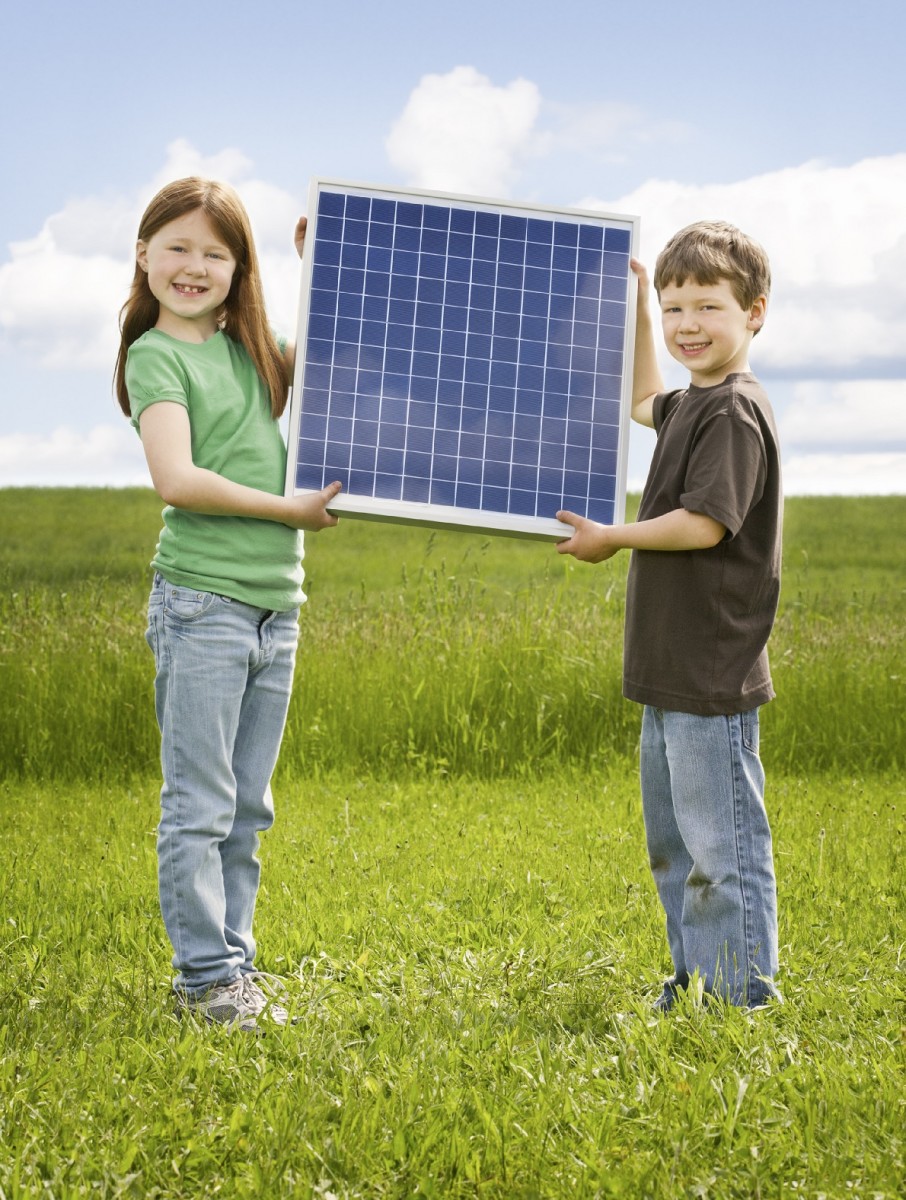
Building a solar still is a fantastic family project, and teaches children a great deal about how energy, water, distillation, water vapour and condensation work.
Solar still
A solar still is a device which distills water using solar energy in order to turn dirty or suspect water into undoubtedly clean water.
They can be useful in areas which lose power as a result of extreme weather such as hurricanes.
They are also extremely useful to demonstrate to children, in an interesting and practical fashion, concepts of evaporation, condensation, and conductivity.
- Desert Survival: The Solar Still
An article about how to build an ad hoc solar still when one is needed - fascinating!

Building a solar still
There are several different ways to do this, but this is one way I was taught to do it at, of all places, a Girl Guides Camp!
It does work - we built several, and they did indeed produce distilled water.
You need:
- A sheet of plastic or tarpaulin (must be water-proof), approx. 5 ft by 5ft, or bigger;
- Something to catch your water, such as a cup, bottle or (small) bucket;
- A stone, large pebble size;
- Something to dig with, such as a spade or shovel, or anything in an emergency, such as a big stick or sharp stone or even a knife.
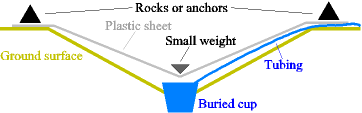
Firstly, dig a hole, about 3 feet by 3 feet by 2 feet deep. Choose the place which gets the most sun per day in the immediate area. You get more water if the soil at the bottom of your hole is damp.
Put your cup / empty tin can / other water catcher at the bottom and centre of your hole.
Put any dirty or doubtful water at the bottom of your hole, so it is thoroughly damp. You can also use seawater. If you don't have any seawater or dirty water, put juicy green plants there, or urine (which will produce clean, distilled water only, don't worry....)
Put the plastic over the hole you've dug, and make sure it's sagging a bit in the middle, over your water catcher.
The use stones, wood and the soil you dug out of your hole to anchor the plastic to the ground. Try to make it sealed, so water vapour doesn't escape around the edges of your plastic sheet.
Lastly, put the stone on the secured plastic, directly over the water catcher.
The still works by causing the damp, dirty water, seawater, urine or succulent plants to produce water vapour. This is prevented from escaping the hole by the plastic.
The stone on the plastic encourages the water vapour to condense, and drop into your water catcher.
- Solar Water Disinfection
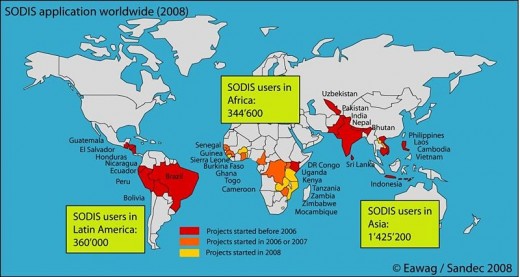
Solar Water Disinfection is a simple method to improve the quality of drinking water in third-world countries using solar UV-A radiation and temperature. This site has an easy-to-follow picture guide.

Solar distillation
If enough water is not produced by a solar still, an alternative method to clean water safely is to fill a clean P.E.T. (type of plastic bottle, commonly used for household drinks) and seal the bottle, and leave it in the sunshine.
Although the water does not boil, it reaches a temperature that together with the effect of direct sunshine makes the water safe to drink.
6 hours of Northern European mid-day summer sunshine is required in order to make the water safe to be consumed, and up to 2 days if its very cloudy.
Glass bottles are not as good, as the sun UV rays are blocked by glass and the benefits of ultraviolet light are therefore lost.
Studies have shown that in countries and areas where there is not clean water, a solar water disinfection method reduces stomach upsets by between 30 and 80%.